
Episode 9.6: "INVASION: UFO" (part 6: The Final Disclosure), feat. Susan Palmer, Gideon Reid, and Erica Lukes
- Michel Gagné

- Feb 27
- 5 min read
Updated: 3 days ago

"What Planet does God Come From?"
(Paranoid Planet, Episode 9.6A, Introduction)

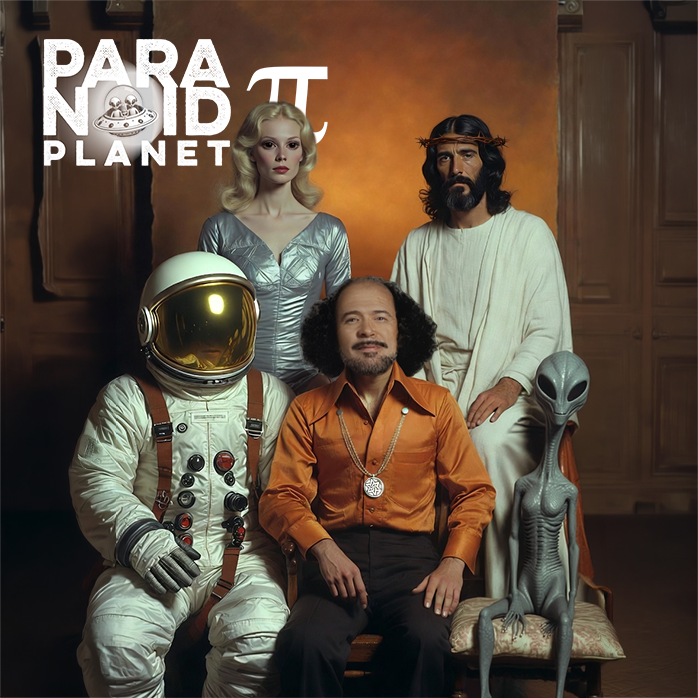
Today on the program, we will be talking about Ufologist religions with sociologist Susan Palmer, who has spent much of her career researching (and interacting with) new religious movements—or what some might call “cults”—with a special interest in the Raëlian movement, a self-described free-love community that originated in France, which mixes Biblical scriptures, New Age mysticism, anti-Catholicism, and pseudoscientific theories about space travel and human cloning, packaged in an eccentric UFO gospel, much of which serves the galactically-sized ego of its founder and leader Claude Vorilhon (better known as Raël), a man who describes himself as the half-brother of Jesus and the son of Yahweh Elohim, a space scientist responsible for creating human life on earth.

As a sociologist of new religions, Professor Palmer prefers to maintain a neutral stance on the beliefs we will be discussing, and has even sometimes come to the defense of such groups when accusations against them—namely about the sexual abuse of minors—seem to go beyond the available evidence. In some ways, I believe Palmer’s position is justified. After all, one cannot claim to be an objective researcher while at the same time engage in public kangaroo courts. On the other hand, and you’ll likely detect this in our conversation, I’m much more inclined to see Claude Vorilhon as an imaginative charlatan and charismatic con-man, who has masterfully concocted a seductive mythology combining UFO-lore, scientistic psychobabble, and anti-religious polemics to attract gullible and emotionally vulnerable sycophants who will furnish him with wealth, admiration, and sex on demand. Not a homicidal narcissist à la Jim Jones or David Koresh, but perhaps not all that different from Scientology’s L. Ron Hubbard or the Siberian Messiah Vissarion (See episodes 3.3 and 3.4) whose insidious and self-serving teachings took decades to manifest themselves as truly harmful and deceptive.
It is of course possible that Mr. Vorilhon believes his own teachings. In which case he may be less like Hubbard and Vissarion and more like Mustapha Mond, the amoral World Controller of Aldous Huxley’s Brave New World, whose dream of world peace required that everyone’s sexual inhibitions be cast aside like a pair of froufrou underwear. But then, the libertine citizens of Brave New World are anything but free-thinking and empowered humans, but more like moronic worker bees, who are kept placid and docile with large doses of Soma and regular stints at the Orgy-Porgy.

The renown Swiss psychiatrist Carl Jung argued that belief in “flying saucers” and alien visitors was a type of coping mechanism that appealed to those who longed for an inspiring religious mythology but felt stuck in a technological and science-obsessed present that left no room for traditional religion or the supernatural. (Palmer & Sentes, in Tumminia, p.60). That certainly seems to apply to the Raëlian movement and their mythology, in which the Biblical God has become a flesh-and-blood astronaut, divine revelations are seen as interstellar communications using advanced alien technologies, and eternal life has been replaced with biological cloning and digital memory transference. (Saliba, 1995, qtd in Palmer & Sentes, ibid., p.64).
According to British folklorist and journalism professor David Clarke, the author of How UFOs Conquered the World, “one of the paradoxical lessons of the [UFO] phenomenon is not what it tells us about extraterrestrials, but what it reveals about ourselves.” (Clarke, p.265) It projects our own fears, desires, and concerns onto a cold and mechanistic universe, from which we then extract a meaningful story that tells us that we’re not alone, that we are valuable and sought after by our space brethren, that they will help us build a worldly utopia, and that we—the willing believer—are not responsible for our world being so full of sadness and misery. Clarke adds: “Those who believe intelligent, highly advanced extraterrestrials are coming here to help us solve our problems, or to stop us from destroying ourselves, are expressing sincere but purely human concerns. They expose the existential anxiety that lies at the heart of the phenomenon.” (p.266)

The genius of Raël—an evil genius, perhaps, as some of his ex-followers describe him—is his ability to weave self-help, science, pseudoscience, hook-up culture, and Biblical theology into a modernistic worldview that is life-affirming, self-affirming, and freedom-affirming. But then just because something tastes good, that doesn’t necessarily means that it is good, and just because a charismatic leader tells you that he is devoted to your well-being, it doesn’t mean that he actually is.

M.J. Gagné, 2026.
Documents related to this episode: *
Episode 9.6A
Aldous Huxley: Brave New World. Chatto & Windus, 1932. (public domain).
David Clarke: How UFOs Conquered The World: The History of a Modern Myth. Aurum Press, 2015.
Susan J. Palmer and Bryan Sentes: "Presumed Immanent: The Raëlians, UFO Religions, and the Postmodern Condition," in Diana G. Tumminia, ed.: Strange Worlds: Social and Religious Dimensions of Extraterrestrial Contact. Syracuse University Press, 2007.
Susan J. Palmer: Aliens Adored: Raël's UFO Religion. Rutgers University Press, 2004.
Raël: The Alien Prophet (Netflix Miniseries, 2024). dir. by Antoine Baldassari and Manuel Guillon. Written by Marc Ball and Alexandre Ifi.
Aux frontières du Raël. (France 2, 2002). INA Société.
Michael Barkun: A Culture of Conspiracy: Apocalyptic Visions in Contemporary America. Second Edition. University of California Press, 2013.
Episode 9.6B

Encounters (TV Mini Series), Season1, Episode 2: "Believers". Dir. John Jopson. Netflix, 2023.
Gideon Reid (blog). https://gideonreid.co.uk/
Gideon Reid: "Science Fiction and The Carl Higdon Alien Encounter Story", 22 February 2025.
Gideon Reid: "The Abduction of Margaret Keane," 18 July 2023.
Gideon Reid: "Les évènements mystérieux de l’école Ariel : l’hypothèse des marionnettes," Scepticisme scientifique, 14 octobre 2024. (translatred from the English: "The Puppetry Hypothesis: The Mysterious Events at Ariel School, Zimbabwe – 16 Sept 1994," 14 July 2022).
Gideon Reid: "A Closer Look at Encounters and the Ariel School Sighting," Skeptical Inquirer, Volume 49, No. 6, November/December 2025.
Gideon Reid: "The influence of sci-fi media on Zimbabwe’s Ariel School UFO sightings," The Skeptic, 16th March 2026.
Toby Ball: Strange Arrivals Podcast (2020-2023). Grim & Mild/iHeart. (S3,E2: "Excited and Scared at the Same Time (Ariel School, part 1)"; S3,E3: "Puppets (Ariel School, part 2)," featuring Gideon Reid;)
Alexa Clay: "Growing Up Alien," Aeon, 17 January 2014.
Charlie Wiser: "Ariel School: Something glinting in the trees, September 16, 1994, Ruwa, Zimbabwe," Three Dollar Kit, 2022.
Thomas E. Bullard: The Myth and Mystery of UFOs, University Press of Kansas, 2016.
Bullard, Thomas E.: What’s New in UFO Abductions? Has the Story Changed in 30 Years? MUFON Symposium Proceedings,1999.
Bullard, Thomas E.: UFO Abductions: The Measure of a Mystery. Volume 1: Comparative Study of Abduction Reports. The Fund for UFO Research,1987.
Bullard, Thomas E.: UFO Abductions: The Measure of a Mystery. Volume 2: Catalogue of Cases. Fund for UFO Research,1987.
Bullard, Thomas E.: What’s New in UFO Abductions? Has the Story Changed in 30 Years? MUFON Symposium Proceedings,1999. (NOTE: Scroll down to page 401)
The Manhattan UFO Abduction (TV Miniseries). Dir. Vivienne Perry and Daniel Vernon, Netflix, 2024.
Episode 9.6C
***Under Construction***
* All copyrighted video and audio clips are used for educational purposes only under "fair use" regulations.


Comments